Copy File Path to Clipboard

April 13, 2008 – 2:31 pm by gabe | 2 Comments »

Let’s say you’re sending an email via your Gmail or other Web email account and want to attach a file. Or maybe you’re uploading a file to your blog or just about any other Web-based application, but you’d rather not bother with that annoying Browse button since you’re already looking at the file on your desktop or in an open window. What do you do? Unless you’re using Outlook and can simply drag ‘n drop the file into your email message, it can be a pain to get a file into a Web email or Web app.

Enter a super-simple utility that will make this process really easy: ClipboardPath. Just download and install it, and then you’ll be able to right-click on any file to Copy Path to Clipboard:

Copy Path to Clipboard

…then simply press control-V to paste your file into your Web-based email attachment field, WordPress file upload field, or whatever Web application you’re using:

Control-V to paste

If there’s a field with a browse button, you can kiss that browse button goodbye.

[ Subscribe to gabeanderson.com via email or RSS feed. ]

Faster Downloads with Internet Download Manager

April 9, 2008 – 8:38 am by gabe | No Comments »

Now that you know how to hide the annoying Firefox downloads status window, it’s time to make your downloads really scream.

IDM

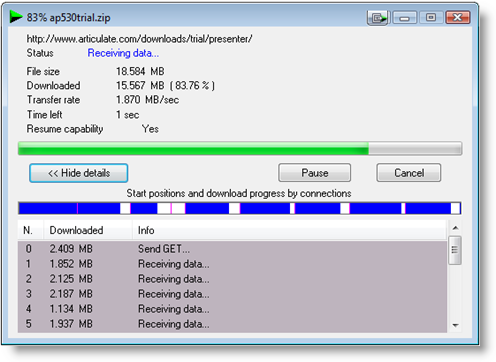
Enter Internet Download Manager (IDM) — the great little utility with the ugly logo. Once you start using IDM, you’ll never want to go back. Downloads are so fast — I get nearly 2 MB per second download speeds — that I actually had a hard time capturing this screenshot of an 18-megabyte download in progress:

Internet Download Manager

Sure, part of all that speed is due to my rockin’ Road Runner Turbo cable Internet connection, where I’ve clocked up to 15 megabits per second download times, but believe me when I say that you’ll notice a huge difference with IDM.

It also gives you all these cool features:

  • Automatic file type download connection
  • Auto-segmenting of downloads into directories based on type
  • Download scheduling
  • YouTube video grabbing
  • Download resume
  • And lots more features

Get IDM and super-fast downloads will be yours!

[ Subscribe to gabeanderson.com via email or RSS feed. ]

How to Hide the Firefox Downloads Status Window

April 7, 2008 – 8:52 am by gabe | 8 Comments »

I don’t know about you, but when I download something, I just want to click a link, have the file or application download, then get to it when I’m ready to open the file or launch the application. If I’m downloading a large file, especially, I don’t need to watch the status. I’d rather get back to work on other stuff and I certainly don’t need to see this window:

Firefox Download window

Hiding this status window is as easy as 1, 2, 3 (4, 5):

  1. Open up a new tab in Firefox (control-T, as you might recall from my earlier post on Firefox shortcuts).
  2. Type about:config into the address bar and hit Enter.
  3. In the Filter field at the top, type download:

    download filter

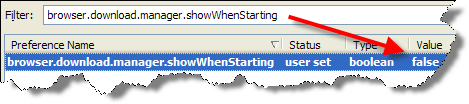
  4. Look for the option called browser.download.manager.showWhenStarting (you can also filter for exactly that phrase).
  5. Double-click that option and the value will change to false:

    browser.download.manager.showWhenStarting

That’s it! Next time you download a file, you don’t have to worry about the annoying status box, but you can check on it at any time by pressing control-J to open the window.

[ Subscribe to gabeanderson.com via email or RSS feed. ]

AutoHotkey: Script Shortcuts, Mouse Clicks, More

April 1, 2008 – 9:00 am by gabe | No Comments »

Yesterday I downloaded a great little application that a coworker recommended: AutoHotkey. Similar to Texter or other utilities that allow you to assign keyboard shortcuts to input text strings, AutoHotkey does all that and more. And, unlike Texter, it works on Vista (and XP), and I haven’t run into the same little quirks that I’ve run into with Texter in the past (scripts would go missing, keyboard shortcuts wouldn’t work).

AutoHotkey

I’ve only just scratched the surface of what’s possible with AutoHotkey, which allows you to do things like the following:

  • “Automate almost anything by sending keystrokes and mouse clicks.”
  • “Create hotkeys for keyboard, joystick, and mouse.”
  • “Expand abbreviations as you type them. For example, typing ‘btw’ can automatically produce ‘by the way.’”

As just one example of how AutoHotkey goes beyond Texter, yesterday I created a shortcut to create my signature that I use in Outlook replies to customers (by default, I don’t have my sig appear in replies since there’s no reason to include it on internal responses to colleagues) — including bolding some of the text, which is not possible in other scripting apps I’ve used. So now I can just type Ctrl-Shift-S and get the following:

Gabe Anderson
Director of Customer Support
Articulate - Empowering Rapid E-Learning
www.articulate.com

Here’s how to get started with a simple example like this:

  1. Download & install AutoHotkey.
  2. Save & extract this zip file anywhere on your computer.
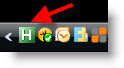
  3. Double-click the autohotkeys.ahk file. You’ll see this green “H” icon appear in your taskbar:

    autohotkeys icon

  4. Right-click the green “H” and select Edit This Script to edit the text to match your own signature (and create other text shortcuts as desired):

    Edit This Script

  5. Save & close the script file.
  6. Right-click the green “H” and select Reload This Script to load your changes (AutoHotkey will tell you if you have any syntax errors in your script):

    Reload This Script

  7. Reply to an email and test it out by typing Ctrl-Shift-S (or whatever hotkeys you chose).

The documentation includes lots of great examples so you can explore what else is possible, from launching applications to activating and manipulating windows.

Give it a shot and have fun! Remember: Less time using your mouse means more productivity.

By the way, you can create multiple scripts, each of which can run in its own instance in your task bar, or create one script file to contain all your goodies. Then you can set each one (or your one master script file) to launch at startup (drop a shortcut in your Start Menu\Programs\Startup folder — path will vary whether you’re on XP or Vista).

[ Subscribe to gabeanderson.com via email or RSS feed. ]

Firefox Tab Tips

March 21, 2008 – 8:21 pm by gabe | 4 Comments »

People who know me know that I’m all about using keyboard shortcuts whenever possible. Why? When my hands spend more time on the keyboard and less time on the mouse, I can maximize productivity and get more done in less time. So long as a shortcut exists and you know it well, the keyboard will always beat the mouse.

firefox

Along those lines, here are some of my favorite Firefox tab tips (some involving keyboard shortcuts, others not):

  • Instead of opening your home page when Firefox starts, set it to restore your tabs & windows from last session (and you can still have a link associated with the home page icon): Tools -> Options -> Main -> When Firefox starts -> Show my windows and tabs from last time. That way, you can open a bunch of tabs for things that interest you or things you have to do, and can always pick up where you left off, should your computer or browser crash, or you simply need to restart Firefox for some reason.
  • Set links that open a new window to open a new tab instead: Tools -> Options -> Tabs -> New pages should be opened in -> A new tab.
  • Control-T, of course, will open a new tab for you to use as you please.
  • Control-Tab to move forward/right to the next tab.
  • Control-Shift-Tab to to move backward/left to the previous tab.
  • Control-W closes a tab.
  • Control-Shift-T will reopen that last tab you just closed — great for those accidental closes. And you can even do it repeatedly to reopen all the previous tabs you had open.
  • Control-Click to open your clicked on link in a new tab (but remain on your active tab).
  • Control-Shift-Click to open your clicked on link in a new tab (and immediately make it your active tab).

Enjoy these time-saving tips!

[ Subscribe to gabeanderson.com via email or RSS feed. ]

Use FeedBurner to Manage RSS & Email Subscriptions

March 16, 2008 – 8:41 pm by gabe | No Comments »

So you have your blog set up. Maybe you even have a few fans read your blog regularly and wait eagerly for your next post to go live (come on, I know you gabeanderson.com 6.0 fans are out there somewhere, right?). Then your readers start asking you about RSS feeds and email subscriptions.

Wait a minute… RS-what? If you’re not sure what RSS is (hint: it stands for Really Simple Syndication and allows people to read your blog without going to your blog), take a minute to check out the first tab in this interaction that my coworker Tom pulled together for his post on 5 Ways Web 2.0 Can Make You a Better E-Learning Designer (the video, RSS in Plain English, was created by commoncraft).

Now that you know what RSS is all about and why it’s a good thing to offer it to your readers via your blog, I’d encourage you to sign up for a FeedBurner account and send all your feed traffic through it.

FeedBurner

OK, but you’re probably wondering why it’s better to use FeedBurner than just leveraging the default RSS link that you get with blogging tools like WordPress, Movable Type, and Blogger, right? Fair enough.

Once you set up your account, you’ll see that FeedBurner gives you 4 major ways to interact with and promote your feed: Analyze, Optimize, Publicize, and Monetize. With that in mind, here are some reasons I like to direct my RSS feed through FeedBurner for my readers:

  • Thanks to the the FeedBurner-WordPress plugin I have installed, I don’t have to worry about which RSS link to use (all variations of my RSS feed go through FeedBurner).
  • I can give you the option to get my feed via RSS feed (note the FeedBurner page that makes sign-up a snap) and/or email subscription (no more than 1 email per day).
  • I can rest assured that all RSS and email subscriptions are being managed accurately and from a single source.
  • I can get overview and detailed stats on how many subscribers I have for both RSS and email, and see how you’re accessing my blog (referral stats, browser type, country, your feed reader, and lots more).
  • I can tell FeedBurner to automatically ping services like Technorati, Bloglines, and NewsGator whenever I publish a new entry, which helps to expand my potential readership by exposing my content on those highly trafficked sites.
  • I can choose to show off how many readers I have with the FeedBurner FeedCount, which is a trusted and accurate measure of the popularity of a blog. For example, TechCrunch proudly displays that it has 698,000 readers. I don’t have nearly that many, so I’m not going to show off (yet).

Here’s what my Feed Stats Dashboard looks like:

Feed Stats Dashboard

Finally, note how at the end of this post (and every other), I give you the option to subscribe to my blog (I added that text and the links in my WordPress “Main Index Page” and “Single Post” templates).

[ Subscribe to gabeanderson.com via email or RSS feed. ]

Collect & Share Data with Google Docs

March 9, 2008 – 12:33 pm by gabe | 2 Comments »

Microsoft Word and Excel are great for creating and emailing around documents, but what if you want to collaborate and share your documents with others online? If you have a Gmail address or Google account, you probably already know about Google Docs. My wife and I have used it for years to safely store our contact list online — and we can both easily add or edit addresses.

google_logo_docs.gif

I volunteer for UPH Saratoga and we’re working to plan a big fundraiser event in a couple weeks (UPH University). Someone asked in our Google Groups discussion list yesterday if we were tracking the names of our “professors” and their guests to whom we had offered complimentary tickets. We weren’t, so I decided to take the initiative.

I went to create a new Google spreadsheet and noticed a cool new feature that would perfectly suit our purpose: Form Collection. One of the drawbacks of Google Docs has always been that in order for someone to collaborate with you, she has to be signed into her Google account, too. This new feature is pretty cool because you can now solicit and collect data from people without their having to be signed into or even owning a Google Account.

Using it is really easy:

  1. Visit Google Docs.
  2. Click New -> Spreadsheet to create your new spreadsheet:

    snag-1752.png

  3. Add some rows for the type of data you want to collect (e.g., name & job title).
  4. Click the Share tab in the upper-right corner.
  5. If you haven’t already done so, you’ll be prompted to save your spreadsheet with a name.
  6. Click Invite people and select the radio button to fill out a form:

    snag-1751.png

  7. Click the Preview and send form button, which launches a new window.
  8. Confirm or edit your existing column names, or select the link to Add a new question.
  9. Click the button to Preview and send.
  10. Optionally, send the link to your form as an email — or just copy the link.

You can view the sample input form I created right here:

First Name
Last Name
Job Title

powered by Google Docs

Optionally, you can even click the Publish tab to give people the link to view your spreadsheet.

By the way, you may have noticed that I embedded the form directly in this blog entry. How’d I do that?

Here’s how:

  1. Installed the EmbedIt WordPress plugin.
  2. Viewed the source HTML of my input form.
  3. Copied the relevant form submission code into a custom field of this blog entry, according to the EmbedIt instructions.

Enjoy!

[ Subscribe to gabeanderson.com via email or RSS feed. ]

How to Hack Your Nano / Nike+ Run Data When iPod Freezes

March 2, 2008 – 4:28 pm by gabe | 55 Comments »

Today was my weekly Team in Training run — I’m training for and planning to run a marathon to raise money for blood cancer research — and 6.61 miles into the run, my iPod Nano froze on me for the first time in the month that I’ve had it (yes, it let me down after I raved about it in my last post). I was really upset that I was not only going to lose my run data, but that I wouldn’t get the mileage credit for the Articulate miles challenge. I ended up doing another 2+ miles for a total of 8.78 miles.

So on my drive home from the run, aside from being bummed, I started thinking about how to fix this. I thought that there had to be some way to hack into the iPod to recover my lost run data — or at least simulate the run based on similar run data.

Sure enough, I was right: My run data was lost during the iPod crash, but I was given the opportunity to tackle a fun technology challenge.

I got home and started doing some Google searches to research the topic before I just started digging into my iPod’s hard drive. I found a couple resources with the info I needed — “MadeUpName’s” method outlined on runpl.us and WalkBlogRun’s method here — and pieced together my own approach that did the trick beautifully.

Here’s how I did it — proceed with caution and at your own risk to your data and software:

The Setup

Hacking your iPod’s run data requires that you create and edit XML files, so before you can do that, you need to confirm two things (both were already the case for me):

  1. Make sure iPod is set to be a disk (check the Enable disk use box on your iPod Summary tab in iTunes).
  2. Make sure you can see hidden system files & folders in Windows (XP how-to | Vista how-to).

The Backup

As is the case whenever you’re editing pretty much anything — especially files that help drive your iPod and iTunes software — always make a backup first since you never know what might happen:

  1. Connect your iPod to your computer.
  2. Navigate to this path (yours may vary):
    G:\iPod_Control\Device\Trainer\Workouts\Empeds\<unique ID>
  3. Copy the entire contents of that folder to your hard drive (2 folders — latest and synched, and 5 files — best, calibration, settings.plist, lastWorkout.xml, and preferences.xml).

    iPod Nike+ run data folder

The Hack

Now that you’ve backed up the key files, you’re ready to get down ‘n dirty. It just so happened that, in my case, the run I did today was the same run I did a couple weeks ago (February 16) in terms of location, mileage, and rough pace. So that made copying the run data fairly easy. Along with that, I also wanted to ensure my last workout and workout summary data were correct.

So there are 3 things you need to do:

  1. Create or copy your new run data (the XML file named after the date & completion time of your run — e.g., 2008-03-02 08;14;25.xml — that’ll begin with the <sportsData> tag inside the file) to your latest folder.
  2. Update your lastWorkout.xml file.
  3. Update your preferences.xml file.

Those last two files are used to display your run summary data in both iTunes and in your iPod. Here’s what the screen with that info looks like in iTunes:

iTunes Run Summary Data

So here’s what I did for each of the above steps:

1. Copying run data.

The first thing I needed to do was to re-create today’s lost run data file by duplicating the data for the last time I did the run and update it with today’s date:

  • Opened the synched folder and located the data file for the last time I did this run (2008-02-16 08;14;25.xml).
  • Copied 2008-02-16 08;14;25.xml to my desktop.
  • Opened 2008-02-16 08;14;25.xml with Notepad.
  • Located the two references to the date & time of the run — in the <time> and <startTime> tags — and changed the values to today’s date (run start time was the same today and last time I did the run):

    run data xml file

  • Saved the file & renamed it to match today’s date and run finish time (2008-03-02 08;14;25.xml).
  • Copied this new file to the latest folder on my iPod — the staging area for runs that have yet to be snyched with iTunes.

Note: I left all other run data the same in my run data file, but you’ll see that you can update all kinds of data to match your estimated values for your run, including these:

  • <duration>
  • <distance> (in both km and miles)
  • <calories>
  • <pace>

You’ll also notice in the middle of your run data file that your iPod records your run distance every 10 seconds. Pretty cool stuff.

2. Updating lastWorkout.xml.

Next, I needed to copy key portions of today’s run data to the lastWorkout.xml file, so here’s what I did:

  • Opened up both 2008-03-02 08;14;25.xml and lastWorkout.xml in Notepad.
  • In my run data file, copied from the beginning of the <time> tag to the end of the <lifetime> tag; this includes all the relevant data you need to paste into lastWorkout.xml.
  • Pasted this data into lastWorkout.xml, overwriting the existing values, of course.
  • Referred to my last run data XML file to update lifetime stats in this section to include this latest run data.
  • Saved lastWorkout.xml.

3. Updating preferences.xml.

Finally, I needed to do some basic math to update my total run data to reflect today’s run:

  • Opened both 2008-03-02 08;14;25.xml and preferences.xml in Notepad.
  • Incremented my <TotalWorkouts> value by 1 (from 11 to 12).
  • Updated the <TotalCalories> value by adding the <calories> value from today’s new run data file.
  • Updated the <TotalSeconds> value by taking the <duration> value from my run data file, minus the last 3 digits since your run data files measure to the thousandth of a second (in my case, the <duration> value was 4236763, so I took 4236 and added it to 30529 to get 34765, which, when converted to hours, checks out to be my correct total: 9.6 hours).
  • Updated the <TotalDistanceMiles> to include today’s mileage.
  • Updated the <TotalWeightWorkouts> value to 12.
  • Left everything else — like <FarthestMile> and <TotalMarathon> — the same since my longest distance still stands at 10.02 miles (last Sunday) and since I haven’t yet run a marathon.
  • Saved the file.

So that’s it! You’re done with the hard part.

The Confirmation

The only thing left to do is to confirm that your hacks worked as expected (you did back up your original files, right?). Here’s what I did to confirm:

  1. In iTunes, ejected my iPod.
  2. Unplugged my iPod and went to the Nike+ screen to confirm my latest run and new totals were reflected.*
  3. Plugged my iPod back into my computer & confirmed latest run & summary data were reflected.
  4. Synchronized my data and uploaded the run to my Nike+ site (I had to login to my nikeplus site again).

* At first, my summary data was showing up in iTunes, but not in my iPod, so I did a force reset using the method suggested by Apple, and after that, the new summary data appeared as expected.

Success! I learned a fun hack and can now rest assured that my run data — at least the mileage totals — remains (mostly) accurate.

Have fun and remember: If you use this method to fabricate run data, you’re cheating no one but yourself. :)

[ Subscribe to gabeanderson.com via email or RSS feed. ]

Use Your iPod Nano & Nike+ to Track Mileage

February 25, 2008 – 8:52 am by gabe | 4 Comments »

You’ve probably seen the commercial. You may even know someone who runs. But you probably wonder: Does that whole iPod and Nike+ thing really work?

Oh yes. And it’s even better than you might think.

Nike+ running overview

I started running in late December 2007 when a group of friends decided to run the Nashville half-marathon. Since then, I’ve gotten really into this running thing and have since committed to run my first marathon in San Diego this year (and to raise money for a good cause in the process).

The Technology of Running

My first 7 weeks of training I didn’t bother timing myself too accurately — I just rounded my times to the nearest minute. After all, I had never been a distance runner before, so my times weren’t too impressive anyway. But then a few weeks ago I decided it was time to get more accurate. I was debating between just a basic, el cheapo watch, a more sophisticated watch like the Timex Ironman Triathlon® 50-Lap Sleek, or going all out and getting an iPod Nano with the Nike+ sports kit.

I’m really glad I went for the most techie of the options: The iPod Nano with the Nike+ sports kit.

Gabe’s iPod Nano

I have an old-school 40 GB iPod from 2004 that I was bringing with me on runs, but it was bulky for running and doesn’t even have a stopwatch. I was also worried about justifying the cost of new Nike shoes along with the new iPod and sports kit. As it turns out, you don’t even need Nike shoes, so my new Asics work great. All you need is an adapter like the SwitchEasy RunAway (which is what I got) or the Marware Sportsuit Sensor+.

Your Personalized Trainer

The iPod Nano is pretty awesome in its own right — the built-in stopwatch is perfect for running even without the Nike+ integration and includes the ability to get split times and store your run history by date. But throw in the Nike+ kit and you take running and your stats to a whole new level.

Gabe’s Personal Records

With the Nike+ kit on your iPod, it communicates directly with the adapter in your shoe and uploads your data to your personalized Nike+ site, so it knows how far, how long, and how fast you go. It’s super-easy to use: Just connect it to your computer via USB and it automatically loads your run data into iTunes, which then sends it to your account on the Nike+ site.

With the Nano and Nike+, you can do all of this cool stuff:

  • Track mileage by run, along with weekly, monthly, and overall totals
  • Specify whether your workout should have a distance or time goal
  • Get occasional voice feedback throughout your run
  • Press the center button during your run for a check of mileage, distance, pace
  • See complete run data on your Nike+ site, including a dot to represent each time you checked status
  • Share run data with anyone via a link (here’s my 10-mile run yesterday) or embed in your Web site or blog (more below)
  • Create route maps and link them to your runs
  • Hear shuffled music or create playlists specific to each of your run distances
  • Challenge your friends in private challenges, or enter public challenges (like Democrats vs. Republicans or Obama vs. Clinton)

Community Challenges

The community aspect of the Nike+ is really cool. My coworker Dave and I are engaged in an Articulate most miles challenge, and you can track the real-time progress of the contest through March 13 right here:

I’ve been running with my iPod and Nike+ since February 11 and have only clocked in 8 runs, but I can’t imagine going back. I rock out to the music, am continuously motivated to improve my per-mile pace as I run, and, as a tech guy, love the ability to track detailed statistics about my running.

[ Subscribe to gabeanderson.com via email or RSS feed. ]

How to Make Firefox Faster (Big Time)

February 18, 2008 – 8:34 am by gabe | 5 Comments »

There are lots of reasons why Firefox has been steadily gaining on Internet Explorer browser market share over the past few years (37.2% as of January 2008): Along with being more stable, faster, and more user-friendly, it’s highly customizable. And I’m not just talking about add-ons.

Say hello to about:config (just type about:config in your address bar to view and edit yours).

The good news, though, is that you don’t really have to know what things like editor.singleLine.pasteNewlines mean — though if you wanted to be able to copy ‘n paste multiple lines into any Web form in Firefox, which is great for, say, doing Google Local searches with addresses you’ve copied, then you’d search your about:config for the editor.singleLine.pasteNewlines preference, double-click it, and set the value to 2:

editor.singleLine.pasteNewlines

But I digress.

Here’s how to make Firefox really scream and your Web surfing experience even faster:

  1. Download & install Firetune (thanks, Web Worker Daily)
    Firetune
  2. Back up your current configuration using the button in the app.
  3. Specify your combination of computer / connection speed (e.g., fast computer, fast Internet connection).
  4. Select Other optimizations and check the box to Enable some performance tweaks common to all configurations.
  5. Click Tune it! and Firetune will update your about:config settings.
  6. For an extra speed boost, visit your about:config and search for network.http.pipelining.maxrequests.
  7. Double-click network.http.pipelining.maxrequests and set the value to 30, which means that Firefox will make 30 get requests at once:
    network.http.pipelining.maxrequests

Note that Firetune makes all the same changes as outlined on this page, except the maxrequests tweak, which also helps quite a bit.

After following these simple steps, you’ll see that the difference in speed is unbelievable. Happy browsing!

[ Subscribe to gabeanderson.com via email or RSS feed. ]